
The CAU Police Department (CAUPD) is a collaborative interactive police agency dedicated to the concepts of campus community involvement and community service. We provide public safety services that are designed to fairly, efficiently, and effectively prevent crime and safeguard lives and property. We provide an environment of safety and security which ensures a peaceful quality of life in the university community by establishing collaborative partnerships with students, faculty, staff and visitors. We strive for positive interactions with outside agencies and maintain a strong, cooperative relationship with the community by respecting differences and fostering a better understanding through communication.

CAUPD employs a community-oriented policing philosophy to improve the quality of safety through our community partnerships and problem-solving approaches. To accomplish this goal, the organizational structure is designed into a 3-watch, 8-hour patrol shift schedule deploying resources 24 hours a day, 7 days a week, including holidays, encompassing investigative services. Officers conduct directed patrols, respond to crimes in progress, mitigate disputes and disruptions, conduct residential facility town hall meetings and safety training classes, maintain and direct emergency management functions, provide security for athletic events and on-campus social activities, and provide valuable safety tips to the community. Our personnel will maintain high ethical standards, training, and professional development ongoing.

CAUPD is committed to transparency and notification. The Department carries out this function by apprising the students, faculty and staff of the University’s on-campus crime statistics through the distribution of the annual “Your Right To Know” Campus Safety Report. Statistical data is also available on the Clery Act Internal Policy website. CAUPD believes knowledge is power and with that power comes awareness, thereby fostering a campus-wide posture of crime prevention and increased public safety. 

CAUPD Headquarters is located at the corner of Lawshe Street and Atlanta Student Movement Blvd. (formerly Fair Street) in the Tanner Turner Building. Stop by and visit. 

Message from Chief of Police
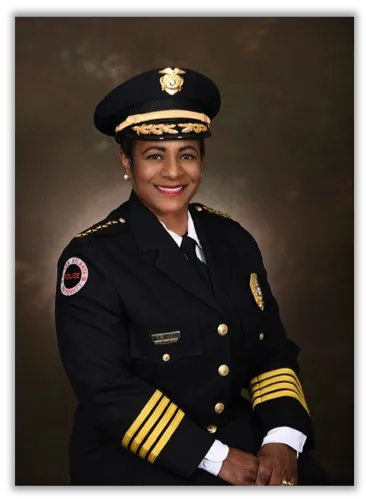
Chief of Police Debra A. Williams in uniform with a police captain's hat.

Chief Debra A. Williams has over 39 years of law enforcement experience. She began her career with the City of Atlanta Police Department in 1983, until retiring in 2011, as a major in rank. After retiring with the City of Atlanta Police Department, she served as a Senior Police Advisor and Deputy Team Leader responsible for providing law enforcement instructions, mentoring, and the delivery of training programs with the Narcotics Affairs Section in Mexico. In 2014, she joined the Clayton County Public Schools Police Department as the major over day-to-day operations.

In August 2018, “she was called” as the Chief of Police for Clark Atlanta University Department of Public Safety. She place emphasis on “called” because she feels that it is a calling for her to serve in this capacity. During her tenure at Clark Atlanta University, she has helped bridged the gap with the students, faculty, staff, alums and the community by implementing several programs initiatives and events. During her short tenure, she has received the Leadership Award from the School of Education in 2018 and an Honorary Service Award by the Student Life Awards in 2019. The National Society of Leadership and Success recognized her for Excellence in Service to Students Award and the Atlanta University Center Consortium for her Leadership of the Public Safety and Campus Security Council. She was also recognized as one of the nominees for Georgia’s Chief of the Year at the 2020 Georgia Association of Chiefs of Police Conference.

She has a Master of Science, Bachelor of Arts in Criminal Justice and an Associate Degree in Accounting. She is a graduate of Georgia Association Chief of Police Executive Training and the Police Executive Research Forum’s (PERF) Senior Management Institute of Policing (SMIP) in Boston, Massachusetts. She participated in the Anti-Defamation League (ADL), where she visited Israel and received training on Intervention Strategies for Domestic and Gender-Based Violence in San Salvador. Furthermore, she has received several commendations throughout her career, such as 2009 Manager of the Year for APD, Female Officer of the Year for the State of Georgia and finalist for Female Officer of the Year with the International Association of Women Police. Additionally, she is a Georgia State POST Certified Senior Instructor, enjoys leading exercise classes and playing golf.

In closing, she is married to retired City of Atlanta Police Major Khirus E. Williams. More importantly, she is a servant member of The Enon Church in College Park. Proudly, Chief Williams is a member of Delta Sigma Theta Sorority Incorporated. Lastly, she is a member of National Organizations of Black Law Enforcement (NOBLE), the International Association of Chiefs of Police, and the Georgia Association of Chiefs of Police, Historically Black Colleges & Universities Law Enforcement Executives & Administrators and the International Association of Campus Law Enforcement Executives.

Sincerely,

Debra A. Williams
Chief of Police / Director of Emergency Management
Clark Atlanta University Police Department

Contact CAU Police Department (CAUPD)

Emergency: (404) 880-8911
Non-Emergency: (404) 880-8623
CAU Department of Public Safety Lawshe Street at Student Movement Boulevard
223 James P. Brawley Drive, S.W. Atlanta, GA 30314

Command Staff


Michael Butler
Captain

Kenneth Tatum
Lieutenant Detective

Cree Smith
Office Manager

Demond Conner
Sergeant

Trista Stanley
Communications Director

Kawaskee Brown
Sergeant

Jalisa Munnerlyn
Sergeant

Public Safety Units


Communications

The Mission of the Communications Unit is to provide expedient and courteous service in a professional and proficient manner to students, faculty, staff and visitors. The Communications Unit is responsible for receiving and relaying all relevant and related data of calls for service for Emergency and Non-Emergency incidents which occur within the jurisdiction of the Clark Atlanta University Police Department and other agencies having joint jurisdiction.

The Communications Unit maintains communication over emergency, non-emergency, administrative telephone lines and call boxes. The Communication Unit also monitors the University’s surveillance cameras system of which encompasses numerous cameras located throughout the campus. With a staff of six communications officers and one Terminal Agency Coordinator (TAC), our communication’s unit provides services twenty-four (24) hours a day, 7 days a week, 365 days a year. In addition to the telephone system, the communications unit utilizes the Motorola transmitting system, a total recall digital voice recording unit and the Criminal Justice Information System Network to access GCIC/NCIC files. The TAC also serves as the communications supervisor for the department, and provides to the Georgia Bureau of Investigation (GBI) with a monthly report of the statistical data of crimes and criminal activity on the Clark Atlanta University campus.

Investigations Unit

The Investigations Unit is commanded by the Deputy Chief and includes two (2) investigators. The Investigations Unit is responsible for investigating crimes, following up on reports initiated by the Patrol Unit for every criminal case reported to the Clark Atlanta University Police Department. Every complainant is contacted, regardless of how minor the offense may appear, to determine if any other pertinent information is available on the case and to ensure the complainant still wishes to file charges. Each reported criminal incident is assigned to an investigator. These assignments consist of working crime scenes, conducting interviews and processing charges. Also, to access areas on campus that may be experiencing an unusually high number of reported criminal activities, to target those areas for “special attention.”

The Investigations Unit is also responsible for conducting background investigations on all potential applicants for the Clark Atlanta University Police Department.

Patrol Unit

The patrol function is the most visible asset of the Department of Public Safety. The principal duties of an officer while on patrol is to attempt to prevent violations of the law, enforce the policies, rules and regulations of the University, check for suspicious persons and render aid and assistance.

Police Officers perform services through foot patrol, vehicle and bike patrols twenty-four (24) hours per day. While on foot patrol, attention is primarily focused on common areas, the buildings and the activities around and in them. On vehicle patrol, this attention is redirected to the parking areas and campus properties on the perimeter of the campus and any activities around or in them. The bike patrol focuses its attention on the campus interior, parking areas, and the promenade. Officers of the Department of Public Safety enforce Georgia criminal and traffic laws while on patrol. Violations of those laws are cited with Uniform Traffic Citations which are processed by City Of Atlanta Municipal Court and the Fulton County Justice Center.

The Department of Public Safety shares the responsibility for the patrol of the city streets around Clark Atlanta University with the City of Atlanta Police Department.

Records Unit

The Clark Atlanta University Police Records Unit is responsible for the maintenance of all incident reports which occur within the Clark Atlanta University jurisdiction. Administrative personnel distribute and release Incident/Accident reports upon request and maintain a record of released reports. One may obtain a copy of an Incident/Accident report by visiting in person the Clark Atlanta University Police Department, in the Tanner Turner Building between the hours of 9:00 a.m. and 5:00 p.m. Please allow five business days for processing of reports.

Training Unit

The Training Unit is a unit of the Patrol Bureau and focuses its attention on the following three categories:

  • Basic/Orientation Training
  • In-Service Training
  • Advanced Training