

Meet Clark Atlanta University's 2026–2027 Graduate SGA Leadership
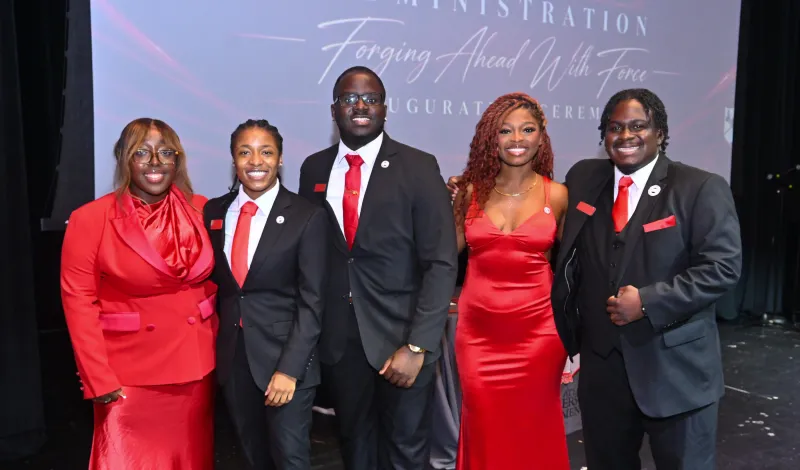
As the 38th Graduate Student Government Association (SGA) administration begins its term at Clark Atlanta University, its leaders are focused on strengthening graduate student representation, expanding access to resources, and creating a stronger sense of connection across the university community. The administration was formally inaugurated on October 12, marking the official start of its term and a new chapter of graduate student leadership at CAU.
The 2026–2027 Graduate Student Government Association Executive Board includes:
- Nyah Dennis, President, Graduate SGA Executive Board
- Joseph K. Bannerman, Vice President, Graduate SGA Executive Board
- Ay’Maya Murchison, Treasurer, Graduate SGA Executive Board
- Demar Richards, Secretary, Graduate SGA Executive Board
- Simone Ritter, Chief of Staff, Graduate SGA Executive Board
For the 38th administration, this new chapter brought both personal significance and a responsibility to address the evolving needs of graduate students.
Leadership Through Service
For Graduate SGA President Nyah Dennis, a second-year MBA candidate concentrating in marketing in the Class of 2027, the opportunity to serve represented more than an elected position. It reflects years of personal growth, perseverance, and a commitment to leadership through service.
As a first-generation college student, Dennis reflects that there was never a blueprint for her journey. “Everything I have accomplished has been built on faith, perseverance, and the sacrifices of the people who loved me long before I understood the magnitude of what they were giving me,” she said.
Dennis said those experiences have shaped her approach to leadership and strengthened her commitment to serving the students who elected her.
Expanding Access and Advocacy
One of the administration’s central priorities is graduate student funding and the broader question of access to higher education.
Dennis said changes to graduate student funding have created uncertainty for students balancing academic responsibilities with careers, families, and financial obligations. Her administration plans to advocate for greater transparency, resources, and solutions while ensuring graduate students have a voice in conversations affecting their ability to remain enrolled and complete their degrees.
“Education should remain a pathway to opportunity, not a privilege determined by financial circumstance,” Dennis said.
While the Graduate SGA Executive Board will focus primarily on graduate students, Dennis emphasized that questions surrounding affordability and educational access affect students across the university. She sees collaboration between graduate and undergraduate students as an important part of addressing those challenges.
Building a More Connected Campus
Beyond advocacy, Dennis wants to strengthen the sense of community among students across Clark Atlanta University. She sees greater connection between graduate and undergraduate students as an opportunity to create a more unified campus experience, while recognizing that each group brings different experiences and perspectives to the university.
Dennis hopes to create more intentional opportunities for students to connect, learn from one another, and become more engaged in campus life. Graduate students bring professional experience, academic knowledge, and insights from their own educational journeys while undergraduate students contribute energy, creativity, and new perspectives.
For Dennis, bringing those experiences together is ultimately about fostering a stronger sense of belonging across the university.
“Ultimately, I hope my impact extends beyond programs and initiatives,” Dennis said. “I hope it is reflected in how students feel.”
Strengthening Student Representation
Joseph K. Bannerman, Graduate SGA vice president, is serving alongside Dennis, focusing on strengthening the Student Senate and advancing graduate student advocacy. A Ph.D. student in humanities with a concentration in African American studies and in the Class of 2029, Bannerman previously served as a senator and said his election to the Graduate SGA is especially meaningful because it provides an opportunity to take a more active role in strengthening the senate as a representative body.
“As a first-generation graduate student, I am honored that the graduate student body entrusted me with representing them in SGA and advocating on their behalf,” Bannerman said.
Bannerman’s priorities include increasing graduate student involvement, ensuring the Student Senate is fully staffed, and empowering the Senate to function as an equal branch within SGA.
He also hopes to create more opportunities for graduate students to connect with one another and the broader university community while ensuring that both graduate and undergraduate students have meaningful representation.
A Leadership Model Centered on Service
For Dennis, the work of the 38th administration begins with a clear understanding of what leadership should mean: service.
Her approach to leadership has been shaped by her experience as a first-generation college student, as well as the lessons she has drawn from her family and faith. Rather than viewing leadership as a title or position, Dennis sees it as a responsibility to use her platform to create opportunities, advocate for others, and serve the students who trust her to represent them.
That same philosophy guides the administration’s commitment to leadership development. Dennis hopes to encourage graduate students to see leadership as an opportunity available to anyone willing to contribute their knowledge, talents, and perspectives to the university community.
This focus on service connects the administration’s broader priorities, including financial access, student advocacy, leadership development, and engagement. Together, those efforts reflect the administration’s goal of expanding opportunity and ensuring graduate students have the support and resources they need to flourish at Clark Atlanta University.
Leaving the University Better
When considering the legacy of the 38th administration, Dennis returns to a lesson from her grandmother: “Leave things better than you found them.”
For Dennis, that principle extends beyond programs and initiatives. She hopes the administration’s legacy will be reflected in how students experience their time at Clark Atlanta University — whether they feel heard, supported, valued, and connected to their community.
“I hope they remember an administration that genuinely cared about students and understood that leadership is not about being served; it is about serving others,” Dennis said.
Bannerman shares that commitment to service, hoping to strengthen connections among graduate students and build a more collaborative student government. Together, the administration’s leaders envision a Graduate SGA that not only advocates for students but also creates opportunities for them to engage, lead, and support one another.
A Vision for the Year Ahead
Now inaugurated, the 38th Graduate SGA administration is focused on making student voices an integral part of the university experience. Through advocacy, collaboration, engagement, and service, the administration seeks to strengthen the graduate student community and create opportunities for Panthers to grow as scholars, leaders, and members of the Clark Atlanta University community.
Learn more about student involvement, leadership opportunities, and campus organizations at Clark Atlanta University.
For Media Inquiries
For media inquiries please contact Clark Atlanta University at
communications@cau.edu404-703-2914
