

Clark Atlanta University Faculty Join NABJ Conversation on AI and Journalism
As artificial intelligence continues to reshape how news is researched, produced, distributed, and consumed, Clark Atlanta University is preparing the next generation of journalists to navigate an evolving media landscape while staying true to the profession's core principles: accuracy, accountability, critical thinking, and trust.
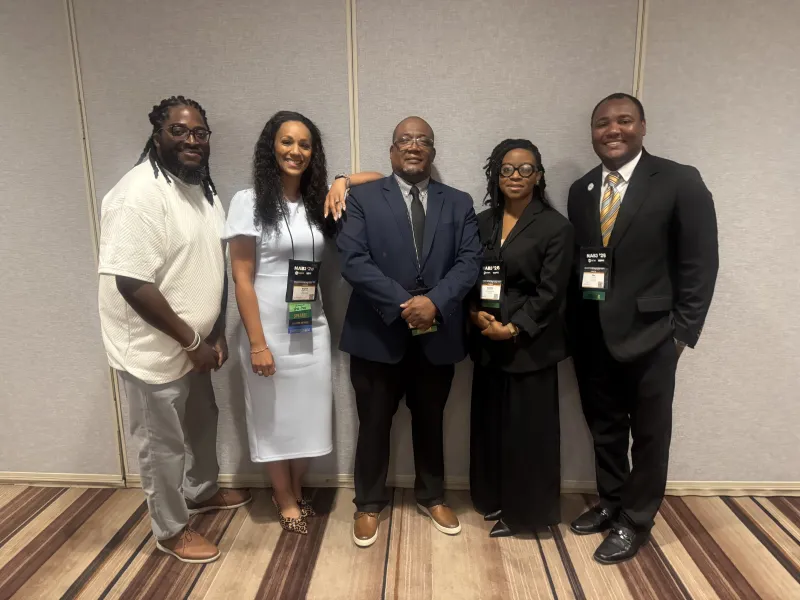
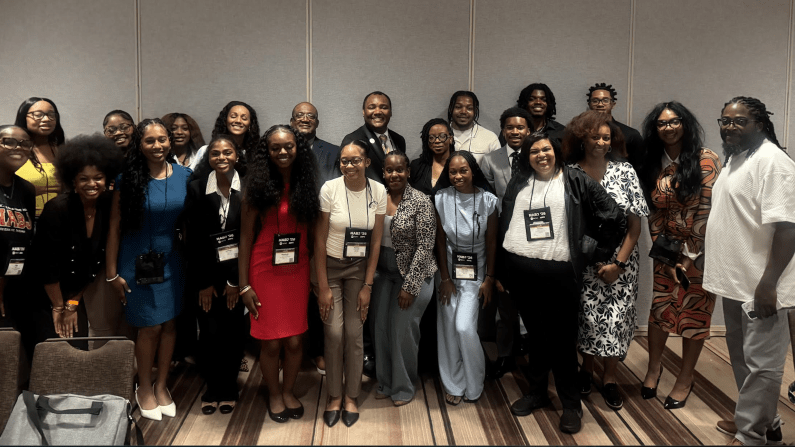
That conversation took center stage at the 2026 National Association of Black Journalists (NABJ) Convention and Career Fair in Atlanta, Georgia, where Clark Atlanta University faculty brought their expertise to the panel, “Artificial Intelligence in the Newsroom: Tool, Threat, or Transformation?” Moderated by Brian Bentley, Ph.D., associate dean of the School of Arts and Sciences and assistant professor of Mass Media Arts, the August 12 panel featured Mass Media Arts faculty members Kamille D. Whittaker, assistant professor of Journalism & Digital Media, and Lynton Felix, adjunct professor, alongside industry professionals Brandi Cummings and Mo Carter.
Held during NABJ’s 2026 convention, themed “Our Revolution: Truth, Power and Black Journalism,” the discussion underscored the importance of ensuring that technological innovation strengthens journalism rather than diminishing human judgment at its core.
Keeping Pace With a Changing Industry
For Dr. Bentley, understanding artificial intelligence is part of a larger responsibility to prepare students for a media industry that has moved far beyond traditional broadcasting.
“Traditional broadcasting has transformed into a dynamic ecosystem driven by emerging technologies and new ways of creating, distributing, and consuming media content,” Bentley said.
Today’s audiences encounter news across mobile devices, social media, streaming platforms, and on-demand services. In that environment, artificial intelligence increasingly influences how stories are researched, produced, personalized, distributed, and consumed.
As the media industry continues to evolve, Bentley emphasized the importance of preparing journalists to understand and adapt to emerging technologies.
“This is important because journalists must stay at the forefront of industry changes and understand how the field is and will continue to be shaped by emerging technologies and evolving practices,” he said.
That adaptability is particularly significant for emerging Black journalists, who are entering an industry where technology, representation and access continue to intersect.
AI as a Tool, Not a Substitute for Judgment
Within the classroom, CAU faculty are approaching artificial intelligence as an opportunity to reinforce the fundamentals of journalism rather than replace them.
Felix emphasizes that distinction with his students, teaching them that AI should function as a tool—not a substitute for their judgment or creativity.
“It can speed up research, transcription, and even the structure of your draft,” Felix said. “My emphasis to them is that the verification, the sourcing, the editorial instinct, still have to come from them.”
Whittaker similarly sees AI as an opportunity to return students to the human elements of journalism, including critical thinking, fact-checking, media literacy, deep listening, research, rigorous reporting, and relationship-building.
“Students need to understand AI well enough to use it responsibly and ethically for things like transcription, research assistance, data organization, and pattern-finding in large datasets while never letting it substitute for the reporting instincts that come from being in a community, asking hard questions, and sitting with sources,” Whittaker said.
For students entering an industry increasingly shaped by automation, that distinction is critical. AI can assist with efficiency, but it cannot replace the lived experiences, curiosity, and relationships that allow journalists to understand the communities they cover.
Preserving Accuracy, Ethics and Trust
The increased use of AI also presents significant challenges for news organizations. While the technology can help journalists synthesize public records, identify patterns in large datasets, and expand the capacity of smaller newsrooms, faculty caution that efficiency cannot come at the expense of accuracy, context, or trust.
AI-generated information can contain errors, flatten nuance or reproduce biases within the data used to train models. For Whittaker, these concerns are particularly consequential in communities that have historically experienced gaps in news coverage or have reason to distrust media institutions.
“The challenges are just as real, though,” Whittaker said. “AI models can flatten nuance, reproduce bias baked into their training data, and tempt newsrooms toward speed over accuracy and deep engagement, which is corrosive to trust, especially in communities that already have good reason to distrust media institutions.”
For Felix, navigating these challenges begins with teaching students to maintain ownership of the reporting process.
“Treat anything AI gives you as an unverified tip, never a finished product,” he said.
That emphasis on verification is part of a broader approach to media literacy, individual voice, and ethical awareness. Felix challenges students to understand not only what AI can produce but how these technologies work, where errors and biases can emerge, and what broader effects their development may have on communities.
Connecting Innovation to the Black Press Tradition
At CAU, conversations about emerging technology are taking place within a much longer tradition of journalism as a vehicle for accountability, representation, and community empowerment.
Whittaker's teaching approach draws directly on the legacy of the historic Black Press, connecting contemporary journalism education to a tradition that has long given communities platforms to tell their own stories and hold institutions accountable.
“This orientation anchors us ethically and allows us to bloom with innovations,” Whittaker said.
That philosophy is also informing the rebuilding of The Panther Newspaper, CAU’s official student-run publication, as a working newsroom. Through multimedia and community-reporting opportunities and partnerships with the Black Press and community media, students are gaining practical experience while developing the ethical and historical foundation needed to lead in a changing industry.
“By connecting ourselves to that lineage, we are working from a blueprint that has been tried and true,” Whittaker said.
Preparing Students for What Comes Next
CAU's Mass Media Arts program continues to combine classroom instruction with professional exposure and hands-on learning. Bentley points to opportunities for students to engage with industry professionals and organizations such as CNN, helping scholars build connections and gain insight into modern media industry expectations.
Faculty engagement with AI is also expanding. Felix noted that CAU faculty have participated in a CITLE-hosted AI workshop focused on practical approaches to classroom integration, discouraging misuse, and evaluating assignments for AI appropriateness.
For faculty, preparing students for an AI-driven industry does not mean waiting for technology to define the future of journalism. It means equipping students to help shape that future responsibly.
The goal is not simply to teach students how to use emerging tools. It is to ensure they understand when those tools are appropriate, when human judgment must take precedence, and how technological decisions can affect the communities journalists serve.
As the media industry continues to evolve, Clark Atlanta University remains committed to preparing journalists who can adapt without compromising the principles of the profession. Through industry engagement, hands-on learning, ethical instruction and a connection to the legacy of the Black Press, CAU scholars are being prepared not only to enter the future of journalism—but to help define it.
Explore Clark Atlanta University’s Mass Media Arts program with a Journalism concentration, preparing students for careers in journalism, media, writing and multimedia storytelling. Learn more about the Journalism program.
Photos courtesy of Dr. Brian Bentley
For Media Inquiries
For media inquiries please contact Clark Atlanta University at
communications@cau.edu404-703-2914
