

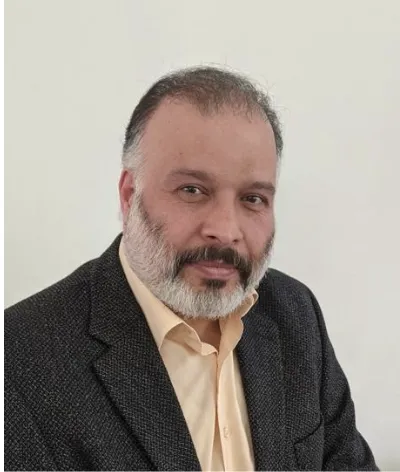
Dr. Mohammad Javani is a tenure-track Assistant Professor in the Department of Cyber-Physical Systems at Clark Atlanta University. His interdisciplinary research lies at the intersection of quantum computing, artificial intelligence, computational physics/chemistry , and nanophotonics, with an emphasis on using AI and advanced computational methods to discover fundamental principles and develop new approaches to complex scientific and engineering problems.
Dr. Javani’s current research focuses on AI-assisted scientific discovery in quantum computing, including the development of methods for identifying efficient quantum algorithm structures, discovering compact quantum representations of physical systems, and understanding the principles governing quantum algorithm design. His research also investigates quantum simulation of atomic, photonic, and quantum-material systems and the application of quantum information science to cybersecurity.
A second major component of his research focuses on artificial intelligence and machine learning for nanophotonics and inverse design. His work explores deep neural networks, explainable AI, model compression and pruning, dimensionality reduction, and data-driven optimization for the design and analysis of multilayer optical structures, metasurfaces, gratings, and other photonic systems.
Drawing on his backgrounds in both physics and electrical and computer engineering, Dr. Javani seeks to bridge fundamental physical science, artificial intelligence, and emerging quantum technologies. His broader research goal is to develop interpretable computational approaches that not only solve complex scientific problems but also reveal the underlying physical and computational principles responsible for their solutions.
Research Areas
- Quantum computing and quantum information science
- AI-assisted scientific discovery
- Quantum algorithms and quantum algorithm design
- Variational quantum algorithms and quantum simulation
- Quantum simulation of atomic, photonic, and quantum-material systems
- Artificial intelligence and machine learning
- Physics-informed and physics-guided machine learning
- Explainable AI and interpretable machine learning
- AI-driven inverse design of nanophotonic structures
- Nanophotonics, metasurfaces, multilayer structures, and photonic devices
- Deep neural network optimization, pruning, and dimensionality reduction
- Quantum cybersecurity and quantum-enhanced cyber defense
Education
Ph.D. in Electrical and Computer Engineering
Georgia Institute of Technology, Atlanta, Georgia, USA, 2024
Research focus: Machine Learning and Artificial Intelligence for Nanophotonics
Ph.D. in Physics
Georgia State University, Atlanta, Georgia, USA, 2014
Research focus: Atomic, Molecular, and Optical Physics
Student Research Opportunities
Undergraduate and graduate students interested in interdisciplinary research involving quantum computing, artificial intelligence, computational physics, nanophotonics, and quantum cybersecurity are encouraged to participate in Dr. Javani’s research activities.
Current and prospective research directions include:
- Developing and evaluating quantum algorithms for scientific computing
- Using artificial intelligence to discover efficient quantum algorithm structures and design principles
- Quantum simulation of atomic, molecular, photonic, and quantum-material systems
- Variational quantum algorithms and hybrid quantum-classical computing
- AI and machine learning for nanophotonic inverse design
- Explainable and interpretable AI for physical systems
- Quantum-enhanced cybersecurity, cyber deception, and quantum honeypots
Students can gain experience in research methodology, scientific computing, quantum programming, machine learning, data analysis, scholarly writing, and presentation of research at professional conferences. Opportunities are available for students interested in developing research toward conference publications, journal articles, graduate theses, and doctoral research.
Students interested in joining the research group are encouraged to contact Dr. Javani to discuss available research projects and opportunities.
Google Scholar: https://scholar.google.com/citations?user=y7wEhXUAAAAJ
